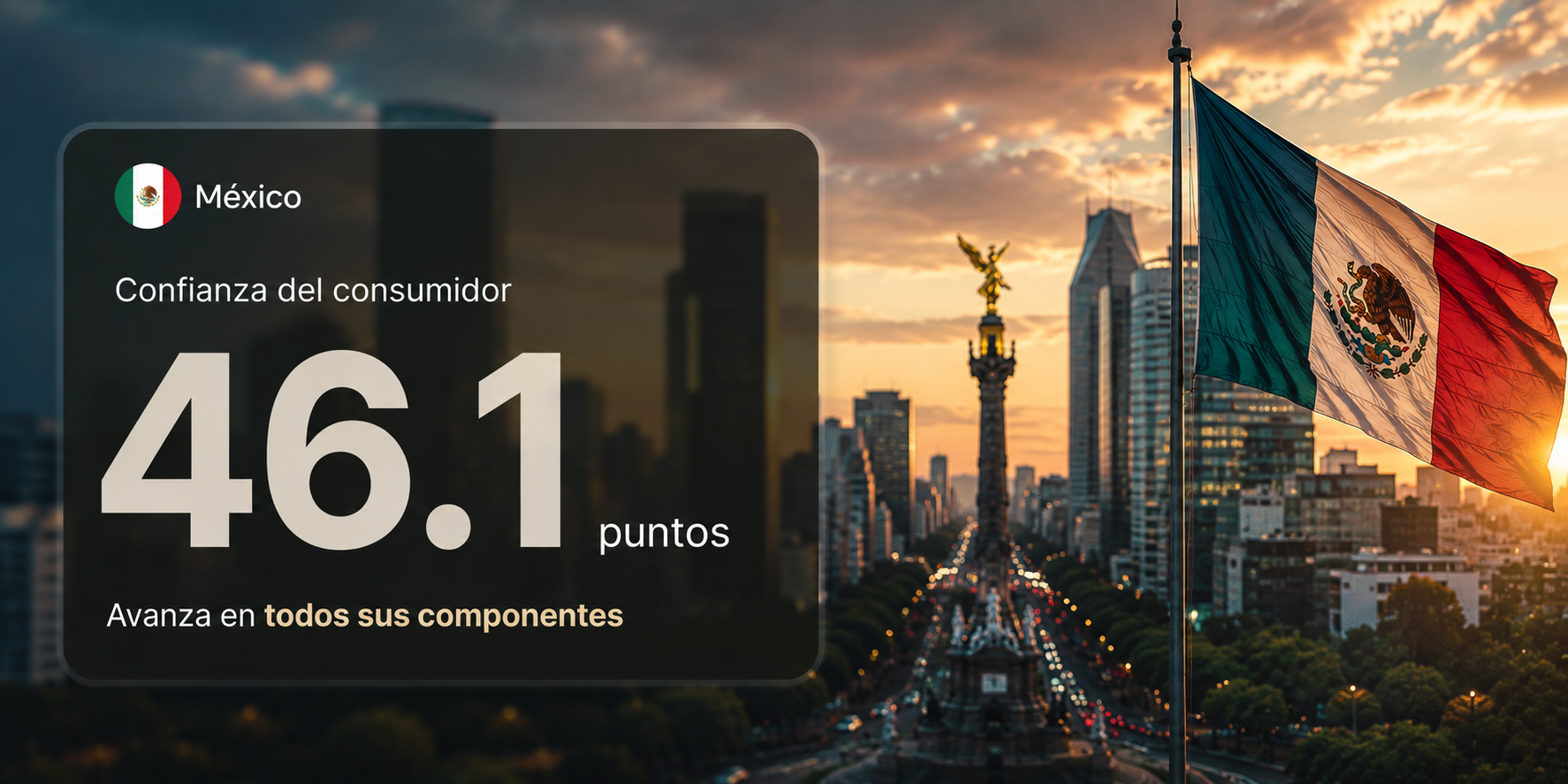
Mexico’s consumer confidence advances across all components
The confidence indicator increased one point month over month, to 46.1 points, with gains across all five components, led by a better perception of households’ current economic situation.
Key points
U.S. trade deficit reaches highest level since 2025
Bank of Japan faces growing pressure to raise rates
U.S. services ISM points to moderate growth
For the rest of the day, the interbank exchange rate (pesos per dollar) could trade between $16.94 and $17.05 in the spot market
Investors remain focused on tomorrow’s key economic reference for the week, the official U.S. employment report (nonfarm payrolls), while continuing to closely monitor oil prices and sovereign bond yields. Futures point to an open with no clear direction, with the S&P 500 up 0.20% and the Nasdaq 100 gaining 0.10%. Oil resumed its advance: Brent is up 0.8% at $96.36 after Trump predicted a "brief" operation against Iran, a statement Tehran contradicted by claiming new attacks on U.S. bases in Kuwait and the United Arab Emirates. The 10-year U.S. Treasury yield fell five basis points to 4.74%.
Monitor
Bolsas / Exchanges
S&P 500
7,693
0.20%
Nasdaq
29,201
0.10%
Dow Jones
53,381
0.50%
IPyC
65,067
0.30%
Monedas / FX (Foreign Exchange)
USD/MXN
16.9921
0.20%
EUR/MXN
19.756
0.50%
EUR/USD
1.1623
0.30%
Índice DXY
99.02
-0.60%
Tasas / Exchange Rates
Treasury 2 años
4.32
-6.9 bp
Treasury 10 años
4.74
-5.0 bp
TIIE 3 meses
6.58
2.0 bp
M Bono 10 años
9.3
-1.0 bp
Commodities / Commodity Markets
Petróleo (Brent)
96.36
0.80%
Oro
4,490
2.40%
What you need to know about the economy and markets
In August 2026, Mexico’s consumer confidence increased 1.0 point month over month, to 46.1 points, although it remained unchanged from the previous year. All five components advanced during the month, led by households’ current situation, which reached 53.9 points, and the expected situation, at 58.9. However, current and future perceptions of the country’s economic situation remained weak, at 40.1 and 45.8 points, respectively, and both declined year over year.
Our Take
The monthly improvement is positive, but the annual stagnation does not yet confirm a change in trend**. Households perceive an improvement in their finances but remain more cautious about the national economy.** In addition, the 2.2-point annual deterioration in employment expectations is consistent with the signs of weakness observed in the July ENOE.
The U.S. trade deficit increased 24.4% month over month in July, to $88.6 billion, its highest level since early 2025. Although the figure was slightly below the $90.2 billion expected by the market, it confirmed a significant deterioration in the trade balance, driven by a 2.8% increase in imports and a 2.1% decline in exports.
Our Take
The widening trade deficit could weigh on U.S. growth during the third quarter. The rebound in imports suggests that domestic demand remains firm, but the decline in exports reflects a less favorable external environment and limits the expected effect of tariff policy on the trade balance.
(image)
S&P Global’s composite PMI for total Eurozone activity stood at 52 points in August. This kept the pace of growth unchanged from the eight-month high recorded in July. Industrial momentum strengthened, while services managed to overcome the initial weakness caused by higher energy costs following the outbreak of the conflict in the Middle East.
Our Take
The region continues to expand moderately, with improved industrial activity offsetting weaker momentum in services. The PMI’s stability reduces the risk of an immediate slowdown, but weak external demand and the increase in energy costs could limit the continuation of the recovery.
Brent crude surpassed $87 per barrel, while West Texas approached $93, amid intensifying attacks between the United States and Iran and the risk of disruptions to crude oil supplies from the Middle East. Preliminary maritime transport data showed that only four commodity vessels crossed the Strait of Hormuz, compared with an average of nearly 13 during the previous ten days.
Our Take
The United States and Iran intensified their retaliatory attacks in recent days, in a scenario oscillating between a possible ceasefire and military escalation. Higher energy prices are also deepening bond sell-offs in global markets amid fears of renewed inflationary pressures.
The Bank of Japan (BOJ) will consider raising its interest rate from the current 1% at its September 18 meeting, amid persistent inflation risks and yen weakness. Although a 25-basis-point adjustment is gaining support, officials do not consider a larger increase necessary. The decision will also be closely watched in Washington, after Scott Bessent expressed his preference for higher rates in Japan during the G20 and in his meeting with Kazuo Ueda.
Our Take
The BOJ’s caution contrasts with increasingly explicit pressure from Washington. This tension, together with uncertainty over the pace of monetary normalization, will keep yen volatility elevated even after the September decision.
Later, at 8:00 a.m., the U.S. services ISM for August will be released. The market consensus expects the indicator to come in at 54.4 points, slightly above the 54.1 recorded in July. If confirmed, the result would point to an economy that continues to show resilience during the second half of the year.
Our Take
We expect the indicator to confirm moderate growth in the services sector, although without significant acceleration. Attention will focus on the activity, new orders and prices components, particularly the latter, given its relevance for assessing inflationary pressures.
Corporate News
Broadcom disappointed investors, despite presenting an ambitious outlook for its artificial intelligence business. The company projected that AI chip revenue will double to $115 billion in fiscal 2027 and double again to $230 billion in 2028. The negative market reactionsuggests that these forecasts were already partially priced in and that investors were looking for stronger signals on profitability, new customers and execution capacity.
Snowflake shares rose as much as 24% after the software company raised its sales forecast, supported by rapid adoption of its AI-assisted coding tool. The result confirms that AI tools applied to developer productivity continue to find strong demand.
Elliott Investment Management accumulated a substantial stake in Deutsche Telekom and called on the German company to abandon a potential merger with its U.S. subsidiary, T-Mobile US. The activist fund’s stance increases pressure on management and raises the question of whether the deal would truly create value for shareholders or add greater complexity to the group’s structure.
The “to-do list”
Review the August services ISM at 8 a.m., ahead of tomorrow’s nonfarm payrolls report.
Track the yen’s performance following today’s jump, as well as any additional signals regarding the Bank of Japan’s September 18 decision.
Monitor Brent’s reaction to the back-and-forth rhetoric between Trump and Iran, as well as the impact of record gasoline and diesel prices in the U.S.
Dedicate 30 minutes to a climbing session at an indoor climbing gym or to pull-ups and lat pulldowns at home, exercises that work the entire upper body.
Remember that today marks another anniversary of the 1934 founding of the Fondo de Cultura Económica by Mexican intellectual Daniel Cosío Villegas.
Quote of the day…
"Imagination is more important than knowledge."
— Albert Einstein
Alejandra Marcos amarcos@kapital.com
James Salazar jsalazars@kapital.com
Guillermo Quechol gquechol@kapital.com
Nahely Suasnavar nsuasnavara@kapital.com
Important Notice: This document is confidential and intended solely for the use of clients and prospective clients of Kapital México Grupo Financiero (“Kapital”). The opinions contained herein reflect exclusively the views of the analysts as of the date of preparation, and such analysts do not receive any compensation from persons other than Kapital. Kapital hereby declares the following:
Kapital does not hold investments in the securities covered by this analytical report that represent one percent (1%) or more of its securities portfolio.
Analysts may hold investments in certain issuers whose securities are the subject matter of this Analytical Report.
No member of the Board of Directors, Chief Executive Officer, or senior officer of Kapital or of the entities comprising Kapital, occupying positions immediately below such level, holds any relevant position in the issuers of the securities covered by this analytical report.
During the past twelve months, where applicable, there have been changes in the direction of the opinions expressed in the analytical reports regarding the issuers covered by this analytical report, in accordance with prevailing economic, political, and social market conditions.
The contents of this document are provided for informational purposes only and do not constitute an offer or investment recommendation. Kapital assumes no liability for decisions made based on this information. Past performance does not guarantee future results.