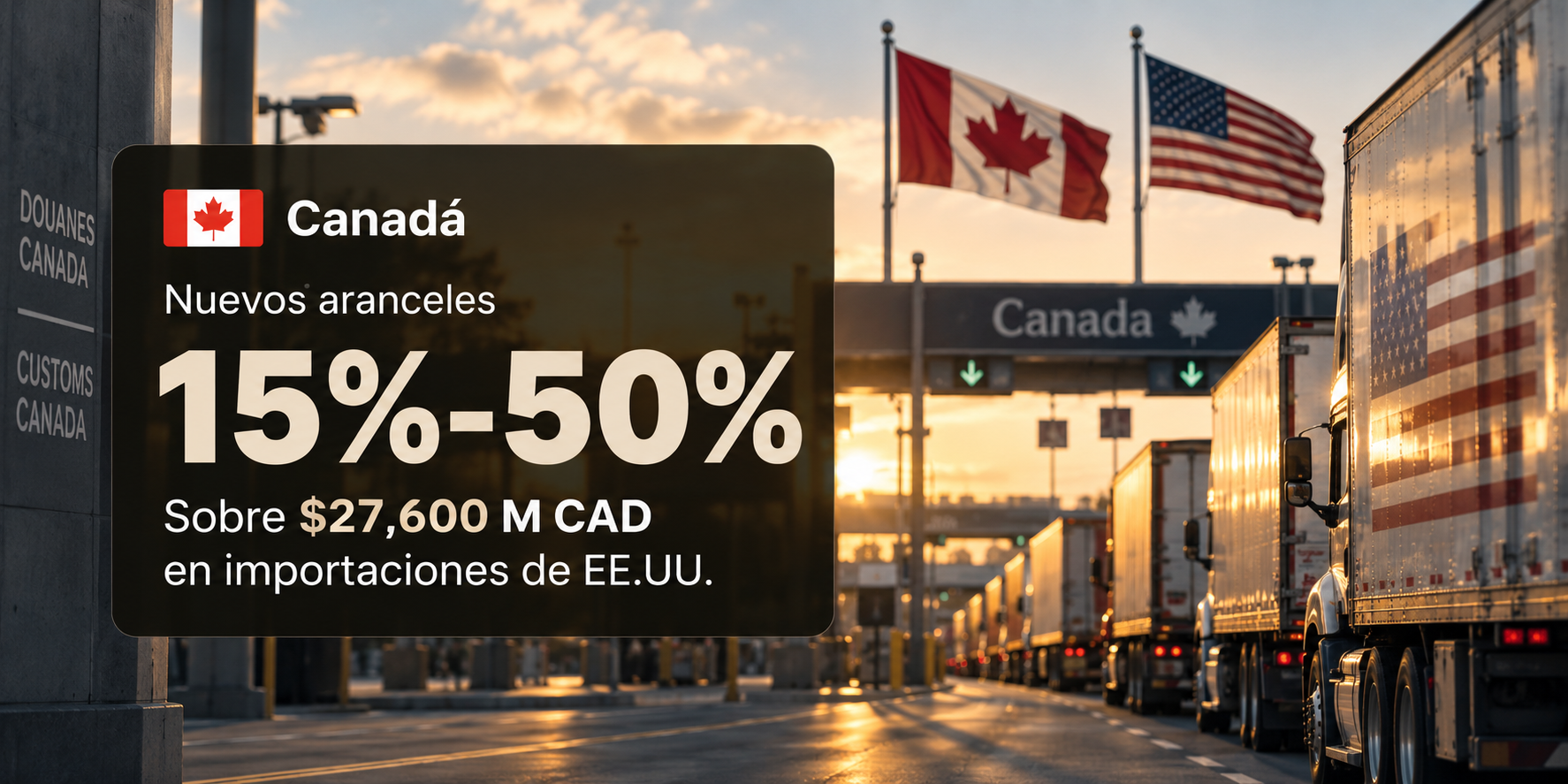
Canada retaliates against the United States with tariffs of up to 50%
Ottawa imposed tariffs ranging from 15% to 50% on C$27.6 billion worth of U.S. imports.
Key points
Mexico’s 2027 Economic Package will put fiscal consolidation to the test
China widens its trade surplus in August
German exports snap five months of gains
Japan revises second-quarter growth higher
Oil nears $100 amid escalating conflict in the Middle East
For the rest of the day, the interbank exchange rate (pesos per dollar) could trade between $16.xx and $1x.xx spot
U.S. equity futures are mixed following yesterday’s Labor Day holiday, amid renewed concerns over inflation, rising oil prices, and the possibility of a Federal Reserve interest-rate hike next week. Against this backdrop, the S&P 500 is down 0.2%, while the Nasdaq 100 is up by the same amount. In fixed income, the 10-year U.S. Treasury yield falls two basis points to 4.76%, ahead of a $58 billion auction of three-year notes that kicks off a busy week of debt issuance. Oil remains under pressure following attacks on facilities in Saudi Arabia and the closure of the Strait of Hormuz: Brent is up 1.2% at $98.12 per barrel, while WTI rises 1.8%.
Monitor
Bolsas / Exchanges
S&P 500
7,709
-0.20%
Nasdaq
29,612
0.20%
Dow Jones
53,083
-0.70%
IPyC
64,848
0.20%
Monedas / FX (Foreign Exchange
USD/MXN
16.9560
0.30%
EUR/MXN
19.6959
0.10%
EUR/USD
1.1618
0.00%
Índice DXY
98.89
-0.30%
Tasas / Exchange Rates
Treasury 2 años
4.36
-1.5 bp
Treasury 10 años
4.76
-2.0 bp
TIIE 3 meses
6.58
2.0 bp
M Bono 10 años
9.3
-0.9 bp
Commodities / Commodity Markets
Petróleo (Brent)
98.12
1.20%
Oro
4,407
0.10%
What you need to know about the economy and markets
Canada implemented tariffs ranging from 15% to 50% on approximately C$27.6 billion worth of U.S. imports in response to levies imposed by Washington. The measures cover steel, dairy, electronics, agricultural products, and household goods, while raising the tariff on certain steel and aluminum products to 50%.
Our Take
Canada’s retaliation increases the risk of a protectionist spiral between two closely integrated economies. In addition to raising the cost of inputs and consumer goods, the dispute could weigh on investment, weaken the Canadian dollar, and complicate the USMCA review, with potential repercussions across North American supply chains.
Mexico’s Ministry of Finance will present the 2027 Economic Package today, with deeper fiscal consolidation expected to be its central focus amid weak growth and mounting spending pressures. Attention will center on how the government plans to reconcile this adjustment with rising pension expenditures, debt-servicing costs, social programs, and Pemex’s financing needs, without a comprehensive fiscal reform.
Our Take
More than the announced targets themselves, the package’s credibility will depend on the composition and feasibility of the adjustment. For markets and rating agencies, it will be crucial to see a path capable of stabilizing debt, together with clearly defined support for Pemex, as a consolidation plan based on favorable assumptions or unsustainable spending cuts would keep perceptions of fiscal risk elevated.
China’s exports rose 25.0% year over year in August to $401.44 billion, driven by demand for technology and artificial intelligence-related products. Imports increased 28.2% to $282.36 billion, while the trade surplus widened to $119.09 billion. During the first eight months of the year, the cumulative surplus reached $805.5 billion.
Our Take
The external sector continues to be one of the main pillars of the Chinese economy, in contrast with still-weak domestic demand. However, the size of the surplus and the strong increase in shipments to the United States could intensify trade tensions and raise the risk of additional restrictions, meaning this momentum is unlikely to come without costs.
German exports fell 0.8% month over month in July to €138.2 billion, their first decline in six months, although they rose 6.1% from a year earlier. The decline was concentrated in shipments to the European Union, China, and the United Kingdom, while exports to the United States increased 19.1%. The trade surplus widened to €21.3 billion, mainly due to a 5.7% drop in imports.
Our Take
The widening trade surplus provides a weaker signal than the headline figure suggests, as it was driven by the sharp drop in imports rather than stronger exports. The rebound in shipments to the United States offset softer demand from Europe and China, but the recovery in Germany’s external sector still looks uneven and vulnerable.
The Japanese economy grew 0.4% quarter over quarter in the second quarter, above the initial 0.3% estimate, while annualized growth was revised from 1.1% to 1.4%. The revision reflected a smaller-than-expected 0.9% contraction in business investment, while private consumption remained flat and the external sector contributed 0.5 percentage points to growth.
Our Take
The revision confirms that the Japanese economy retains growth momentum despite weakness in consumption and investment. Although the expansion remains heavily dependent on the external sector, the figure reduces the case for delaying monetary policy normalization and strengthens the possibility that the Bank of Japan will raise rates again in September.
Following this weekend’s U.S. bombing of Iranian oil tankers, today’s attack by the Houthis, who are backed by Iran, on Saudi Arabian energy facilities adds another layer of escalation, leaving more than 70 people injured. Brent is once again approaching $100, and prices are not expected to ease as long as the Strait of Hormuz remains blocked and shipping disruptions in the Red Sea persist.
Our Take
The scenario from a few months ago, when markets were counting on a peaceful solution that would at least restore some degree of normality to the region by year-end, is fading, strengthening the case for crude oil to once again break above the $100 threshold.
Corporate news
Novartis shares plunged as much as 10% after the Swiss pharmaceutical company suffered its third clinical setback in a week. The latest disappointment involved del-desiran, an experimental treatment for myotonic dystrophy that failed to meet the primary endpoint in a Phase III trial and was acquired as part of the $12 billion purchase of Avidity Biosciences. The result increased concerns over the strength of its drug pipeline.
ASML secured commitments from the world’s leading chipmakers to use its latest semiconductor manufacturing equipment. TSMC expects to introduce it into mass production of advanced chips beginning in 2030, while Intel expanded its collaboration with the Dutch company. The agreements strengthen ASML’s outlook in the development of technology for increasingly advanced semiconductors.
Tamarack Valley Energy agreed to acquire Headwater Exploration for C$10 billion (US$7.24 billion), in a transaction that adds to the recent wave of consolidation in Canada’s oil sector. The deal reinforces the industry’s consolidation trend and seeks to capitalize on economies of scale in an increasingly competitive energy market.
The “to-do list”
Monitor developments in the U.S.-Canada trade dispute, after Trump threatened on Monday to ban the sale of Bombardier jets in the United States.
Keep an eye on the rebound in commodity prices. Copper hit a record high for a second consecutive session, while European natural gas is approaching a three-year high.
The yen is approaching its strongest level of the year against the dollar, a development that warrants close monitoring.
Follow the U.S. Treasury’s $58 billion auction of three-year notes, ahead of the 10- and 30-year offerings.
Remember that today marks another anniversary of the 200-peso banknote entering circulation as legal tender in Mexico in 2008.
Quote of the day…
“In a trade war, both sides lose; the only difference is who loses more.” — Milton Friedman
Alejandra Marcos amarcos@kapital.com
James Salazar jsalazars@kapital.com
Guillermo Quechol gquechol@kapital.com
Nahely Suasnavar nsuasnavara@kapital.com
Important Notice: This document is confidential and intended solely for the use of clients and prospective clients of Kapital México Grupo Financiero (“Kapital”). The opinions contained herein reflect exclusively the views of the analysts as of the date of preparation, and such analysts do not receive any compensation from persons other than Kapital. Kapital hereby declares the following:
Kapital does not hold investments in the securities covered by this analytical report that represent one percent (1%) or more of its securities portfolio.
Analysts may hold investments in certain issuers whose securities are the subject matter of this Analytical Report.
No member of the Board of Directors, Chief Executive Officer, or senior officer of Kapital or of the entities comprising Kapital, occupying positions immediately below such level, holds any relevant position in the issuers of the securities covered by this analytical report.
During the past twelve months, where applicable, there have been changes in the direction of the opinions expressed in the analytical reports regarding the issuers covered by this analytical report, in accordance with prevailing economic, political, and social market conditions.
The contents of this document are provided for informational purposes only and do not constitute an offer or investment recommendation. Kapital assumes no liability for decisions made based on this information. Past performance does not guarantee future results.