Mexico’s Finance Ministry moderates fiscal adjustment for 2027
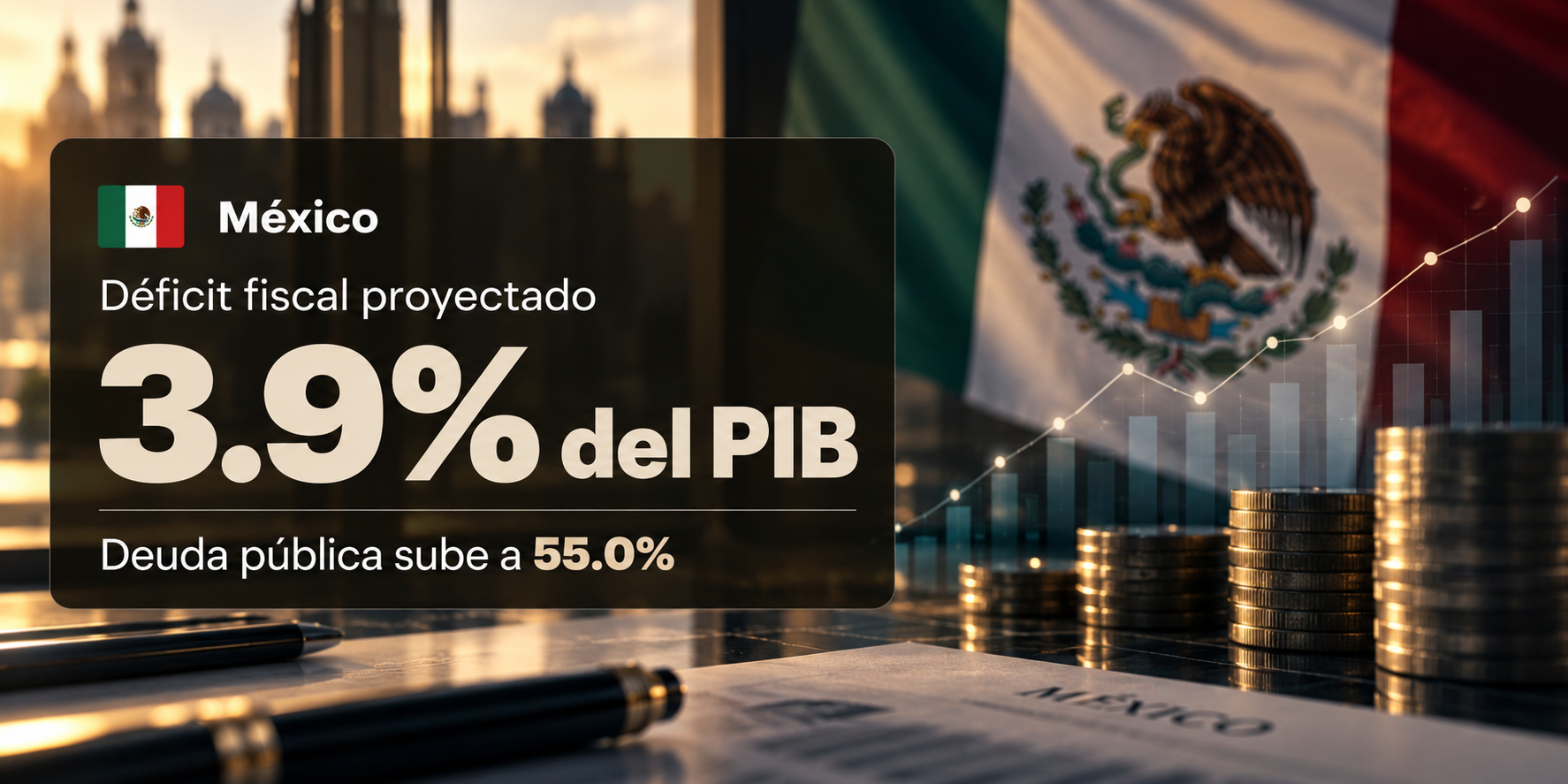
Mexico’s Ministry of Finance projects that the Public Sector Borrowing Requirements deficit will decline to 3.9% of GDP in 2027, but expects debt to rise to 55.0%.
Key points
Consumer prices in Mexico rise less than expected in August; headline inflation at 3.26%
Formal employment in Mexico returns to growth in August
Inflation in China rebounds in August from its lowest levels in six months
U.S.-Canada trade dispute escalates
For the rest of the day, the interbank exchange rate (pesos per dollar) could trade between $16.xx and $17.xx spot
Negative session across major global equity markets. Rising oil prices are intensifying caution over higher inflation risks and the possibility of further rate hikes, while concerns grow that the conflict in Iran could escalate into a regional war. Attention is focused on Friday’s U.S. inflation report, a key input for the Fed’s September 16 decision, as well as Apple’s presentation. S&P 500 and Nasdaq 100 futures are down 0.4% and 0.5%, respectively. Brent is heading for its fourth consecutive session of gains, rising 2.9% and briefly reaching $100.7 per barrel. The 10-year Treasury yield remains stable at 4.81%.
Monitor
Bolsas / Exchanges
S&P 500
7,654
-0.40%
Nasdaq
29,385
-0.50%
Dow Jones
52,514
-0.60%
IPyC
65,071
0.00%
Monedas / FX (Foreign Exchange
USD/MXN
16.8931
-0.10%
EUR/MXN
19.6763
0.20%
EUR/USD
1.1644
0.20%
Índice DXY
98.65
-0.10%
Tasas / Exchange Rates
Treasury 2 años
4.42
1.9 bp
Treasury 10 años
4.81
0.2 bp
TIIE 3 meses
6.58
2.0 bp
M Bono 10 años
9.31
-0.6 bp
Commodities / Commodity Markets
Petróleo (Brent)
100.74
2.90%
Oro
4,400
1.10%
What you need to know about the economy and markets
Mexico’s 2027 Economic Package outlines a gradual fiscal consolidation. The Finance Ministry expects growth of between 1.5% and 2.5%, a budget deficit of 3.4% of GDP, Public Sector Borrowing Requirements of 3.9%, and a primary surplus of around 0.6%. Despite the smaller deficit, debt would increase from 54.0% to 55.0% of GDP, while the adjustment will depend on record-high tax revenues.
Our Take
Fiscal consolidation is moving forward, but it is still not enough to stabilize debt. Meeting the targets will depend on achieving ambitious revenue collection in a moderate-growth environment, while pensions, interest costs, and Pemex continue to constrain spending. For markets and rating agencies, fiscal execution will matter more than the announced targets.
Mexico’s headline inflation stood at 3.26% year-over-year in August 2026, with a monthly increase of 0.20%, coming in below market expectations. The core component, which had already shown signs of a downside surprise in the first half of the month, ended August at 3.88% year-over-year, while non-core inflation rose to 1.13%, driven by higher prices for agricultural products such as onions and eggs, although partially offset by declines in energy prices and products such as potatoes and chicken.
Our Take
Lower-than-expected inflation confirms a gradual easing of price pressures, although the persistence of core inflation near 4% still warrants caution. The result gives Banxico greater room to remain on hold for the rest of the year, although calls for a rate cut in 2027 will likely increase.
Mexico created 38,319 formal jobs in August, an increase of 0.2% month-over-month, following the loss of 19,550 positions in July. As a result, cumulative job creation during the first eight months of 2026 reached 281,397 positions, while total IMSS-affiliated employment rose to 22,798,473, the second-highest figure on record. Over the past 12 months, employment increased by 343,556 positions, equivalent to annual growth of 1.5%, unchanged from July.
Our Take
The recovery in employment in August confirms that the labor market continues to expand at a moderate pace, although it remains far from showing robust momentum, consistent with economic activity that appears set to moderate in the second half of the year.
Consumer inflation in China accelerated in August to 0.8% year-over-year, from 0.5% in July, while producer prices increased 3.8%, compared with 3.5% previously, in both cases largely driven by higher energy costs and other commodities. However, core inflation remained at just 1.0%, suggesting that price pressures remain concentrated in external components and that domestic demand remains weak.
Our Take
The rebound in prices reduces deflation risks, but is unlikely on its own to change the broader picture of weak domestic demand. The main risk is that higher energy and commodity costs eventually feed through into other prices, limiting policymakers’ room to expand stimulus.
The trade dispute between the U.S. and Canada escalated again, after Washington announced new restrictions on Canadian products. Starting September 29, some products, including certain automotive goods, dairy products, and alcoholic beverages, will be subject to import bans, while other products will continue to face additional tariffs of up to 50%.
Our Take
The escalation increases uncertainty surrounding regional trade and raises the risk of further retaliatory measures from Canada. For Mexico, the main focus is the potential impact on the USMCA review, as greater confrontation between Washington and Ottawa could complicate negotiations and increase uncertainty for investment and North American supply chains.
Corporate news
Apple unveils its new product lineup today, as it seeks to fend off growing competition from China and maintain sales momentum ahead of the crucial Christmas season. The company is expected to introduce a foldable iPhone and the new iPhone 18, developments that, if well received by investors, could help the U.S. technology company extend its gains in the stock market.
Alphabet, Google’s parent company, is planning its largest-ever investment in Europe: an artificial intelligence infrastructure expansion valued at at least €13 billion ($15.1 billion) in Finland.
Inditex shares fell 4.9% in Madrid after Zara’s parent company reported disappointing earnings due to higher operating expenses, even as sales continued to grow at a solid pace at the start of the third quarter.
Amazon began selling its first-ever sterling-denominated bond on Wednesday, in a transaction structured across four tranches with maturities of 3, 6, 12, and 19 years. The proceeds will be used for general corporate purposes, a category that in practice includes financing its ambitious artificial intelligence infrastructure investment plan.
The “to do list”
Follow the U.S. Treasury Department’s announcement on the size of the first round of bond buybacks, part of Bessent’s plan to contain long-term yields.
Review today’s $39 billion auction of 10-year Treasury notes, after yesterday’s three-year note auction cleared at the highest yield for that maturity since 2024.
Monitor developments in the U.S.-Iran conflict and their impact on Brent, which rose above $100 today for the first time since July, as well as any further escalation in the trade dispute with Canada.
Remember that today marks another anniversary of the birth of Aurora Reyes, in 1908, considered Mexico’s first female muralist.
Quote of the day…
“The boom, not the slump, is the right time for austerity.” — John Maynard Keynes
Alejandra Marcos amarcos@kapital.com
James Salazar jsalazars@kapital.com
Guillermo Quechol gquechol@kapital.com
Nahely Suasnavar nsuasnavara@kapital.com
Important Notice: This document is confidential and intended solely for the use of clients and prospective clients of Kapital México Grupo Financiero (“Kapital”). The opinions contained herein reflect exclusively the views of the analysts as of the date of preparation, and such analysts do not receive any compensation from persons other than Kapital. Kapital hereby declares the following:
Kapital does not hold investments in the securities covered by this analytical report that represent one percent (1%) or more of its securities portfolio.
Analysts may hold investments in certain issuers whose securities are the subject matter of this Analytical Report.
No member of the Board of Directors, Chief Executive Officer, or senior officer of Kapital or of the entities comprising Kapital, occupying positions immediately below such level, holds any relevant position in the issuers of the securities covered by this analytical report.
During the past twelve months, where applicable, there have been changes in the direction of the opinions expressed in the analytical reports regarding the issuers covered by this analytical report, in accordance with prevailing economic, political, and social market conditions.
The contents of this document are provided for informational purposes only and do not constitute an offer or investment recommendation. Kapital assumes no liability for decisions made based on this information. Past performance does not guarantee future results.