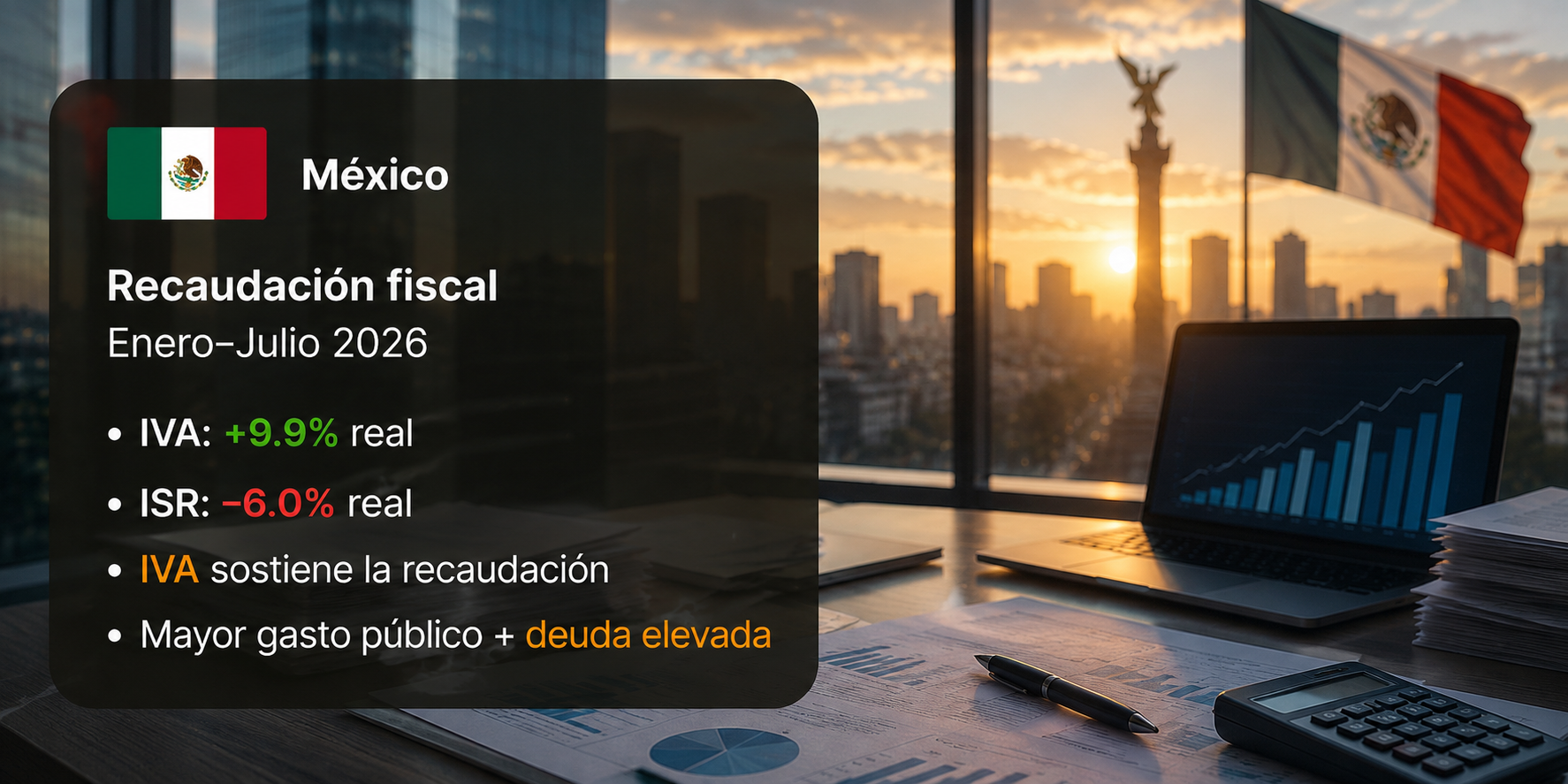
VAT supports tax revenue amid weakness in income tax collection
Between January and July, VAT revenue grew 9.9% in real terms, while income tax revenue fell 6.0%, amid higher public spending and elevated debt.
Key points
The U.S. and Iran exchange attacks for the first time since July
Japanese retail sales rebounded strongly in July
China's private-sector activity continued to contract in August
Germany's inflation reached its highest level since April in August
For the rest of the day, the interbank exchange rate (Mexican pesos per U.S. dollar) could trade between 16.98 and 17.10 in the spot market
Markets are focused on the resumption of hostilities between the United States and Iran after nearly a month of relative military calm, and on its impact on the interest-rate outlook following Kevin Warsh's speech on Friday at Jackson Hole, which was more hawkish than expected. U.S. futures point to a slightly negative opening, with the S&P 500 down 0.4% and the Nasdaq 100 down 0.3%. Oil is driving most of the market moves: Brent crude is trading at $90.90 per barrel, up 3.20%, while WTI is rising 3.38% as geopolitical tensions intensify. In fixed income, the 10-year U.S. Treasury yield remains at 4.72%, while the dollar index is down 0.1%.
Monitor
Bolsas / Exchanges
S&P 500
7,694
-0.40%
Nasdaq
29,398
-0.30%
Dow Jones
53,368
-0.40%
IPyC
65,559
0.10%
Monedas / FX (Foreign Exchange)
USD/MXN
17.0088
-0.10%
EUR/MXN
19.7267
0.00%
EUR/USD
1.1595
0.10%
Índice DXY
99.59
-0.10%
Tasas / Exchange Rates
Treasury 2 años
4.34
-0.6 bp
Treasury 10 años
4.75
3.0 bp
TIIE 3 meses
6.58
2.0 bp
M Bono 10 años
9.19
-1.7 bp
Commodities / Commodity Markets
Petróleo (Brent)
90.90
3.20%
Oro
4,435
-0.40%
What you need to know about the economy and markets
Between January and July, Mexico's budget revenues grew 0.9% in real annual terms, supported mainly by VAT, whose collections increased 9.9%, while income tax revenue fell 6.0%. On the spending side, public expenditure increased 3.5% in real annual terms, although it remained below the budgeted amount, while social development spending rose 9.2%. Public investment posted a strong rebound of nearly 63% in July, but remained in negative territory on a cumulative basis through the first seven months of the year. Regarding debt, the Public Sector Borrowing Requirements balance stood at 51.5% of GDP, while the budget deficit was MXN 268 billion below the projected level.
Our Take
The strength of VAT collections compared with the decline in income tax revenue suggests that consumption continues to support tax revenues, while weaker income tax collections are consistent with a less dynamic business environment. Higher public spending and the rebound in public investment are positive for economic activity, but underspending shows that the fiscal impulse remains limited.
Over the weekend, Washington bombed two launch sites on Larak Island, while Tehran responded by launching missiles at Jordan and drones toward an air base in the United Arab Emirates. The United States had appeared more focused on economically strangling the regime than on direct confrontations, six months into the Iran war. But the renewed fighting served as a reminder on Sunday that the war remains very real.
Our Take
The exchange of attacks has been limited, but it represents the first U.S. strike against Iranian forces in more than a month and underscores the risk of further escalation. The resumption of hostilities between the United States and Iran raises the risk of a broader regional escalation, with direct implications for energy and financial markets.
Japanese retail sales grew 4.0% year over year in July, above the expected 3.0% and accelerating sharply from 0.6% in June. This marks four consecutive months of growth in consumption, led by automobile sales, which increased 16.2% year over year.
Our Take
The result points to a stronger recovery in private consumption, one of the main supports for the Japanese economy. Strong retail sales, together with persistent inflationary pressures, could strengthen the case for the Bank of Japan to continue its monetary policy normalization process.
China's official manufacturing PMI rebounded from 49.2 to 49.8 points in August, exceeding expectations of 49.5, although it remained in contraction territory for a second consecutive month. The non-manufacturing PMI remained at 49.0 points, also marking its second consecutive month below the 50-point threshold, confirming weakness in domestic activity.
Our Take
The marginal improvement in manufacturing reduces concerns about further deterioration, but does not yet confirm a recovery. The fact that both indicators remain below 50 keeps pressure on policymakers to expand stimulus, particularly given weak domestic demand and continued weakness in the services sector.
German consumer prices increased 0.2% month over month in August, following a 0.8% increase in July and below the expected 0.3%. On an annual basis, inflation accelerated to 2.9% from 2.8%, reaching its highest level since April, although it also came in below the 3.0% forecast. The increase was mainly driven by greater pressure from energy prices.
Our Take
The rebound in German inflation reinforces the ECB's cautious stance, although the downside surprise relative to expectations reduces pressure to tighten policy. Attention will remain focused on core and services inflation, while the energy component introduces an additional risk to convergence toward the 2% target and limits room for further rate cuts.
Corporate News
This week, Broadcom and Dell are set to report second-quarter results, providing new signals on the strength of demand for artificial intelligence infrastructure. Beyond the earnings figures, markets will seek to confirm whether the elevated pace of investment in data centers, chips, and servers can be sustained, as well as its impact on margins and companies' growth outlooks.
The patent grant notification from the USPTO represents a significant step forward for Oryzon, strengthening the company's strategy based on LSD1 inhibitors — drugs that block an enzyme involved in regulating gene expression and the maturation of certain blood cells — for the treatment of myeloid neoplasms. Although this is still a notification prior to the formal grant, the development strengthens the value of its intellectual property portfolio and expands the commercial potential of its oncology programs.
Boeing and the union representing its engineers will resumenegotiations this Monday to reach a new labor agreement, at a sensitive time for the company. An agreement would reduce the risk of further labor tensions and potential operational disruptions, while a deadlock in negotiations could add pressure on Boeing, which continues to face significant challenges in stabilizing production and improving its financial performance.
The to-do list
Monitor the yen, which is weakening following Kevin Warsh's Friday remarks, fueling speculation about possible intervention.
Review the global dividend landscape; dividends reached a record last week. How are they affecting indexes and portfolios?
Keep an eye on oil prices and Trump's latest threats, once again targeting Iran's oil hub on Kharg Island.
Go for a 20-minute walk or jog before winding down your activities; start the week at a good pace to keep your body active.
Quote of the day…
"When it comes down to it, there are only excuses or results."
— Chuck Yeager
Alejandra Marcos amarcos@kapital.com
James Salazar jsalazars@kapital.com
Guillermo Quechol gquechol@kapital.com
Nahely Suasnavar nsuasnavara@kapital.com
Important Notice: This document is confidential and intended solely for the use of clients and prospective clients of Kapital México Grupo Financiero (“Kapital”). The opinions contained herein reflect exclusively the views of the analysts as of the date of preparation, and such analysts do not receive any compensation from persons other than Kapital. Kapital hereby declares the following:
Kapital does not hold investments in the securities covered by this analytical report that represent one percent (1%) or more of its securities portfolio.
Analysts may hold investments in certain issuers whose securities are the subject matter of this Analytical Report.
No member of the Board of Directors, Chief Executive Officer, or senior officer of Kapital or of the entities comprising Kapital, occupying positions immediately below such level, holds any relevant position in the issuers of the securities covered by this analytical report.
During the past twelve months, where applicable, there have been changes in the direction of the opinions expressed in the analytical reports regarding the issuers covered by this analytical report, in accordance with prevailing economic, political, and social market conditions.
The contents of this document are provided for informational purposes only and do not constitute an offer or investment recommendation. Kapital assumes no liability for decisions made based on this information. Past performance does not guarantee future results.